
I’m not much of a television viewer but there are few programs that I like to watch. Mostly I enjoy watching Minnesota Viking and Golden Gopher football as well as Twins baseball. I also have a few guilty pleasure shows that I find entertaining but don’t watch with much regularity, such as Judge Judy and Wheel of Fortune. KTTC News out of Rochester, Minnesota is nice to have on the road to stay informed of what’s going on back home. Here are some of the options for TV viewing when traveling and my thoughts regarding the pros and cons of each.
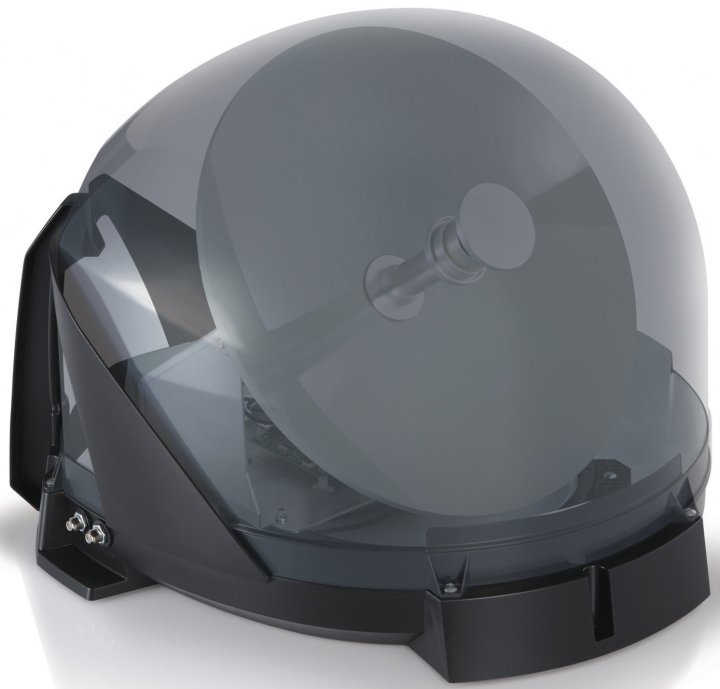
Satellite Television: My motorhome came equipped with a King Dome In-Motion satellite system. This system automatically locates satellites from Direct TV or Dish Network and can even track them while the motorhome is cruising along the highway. This is a great option for the TV junkie with deep pockets. Don’t believe the ridiculous claims of $35/month as the cost. It’s a marketing scheme so expect to pay at least $100/month for the most basic service. If you already have a Direct TV or Dish subscription for your home, you can add a service to your motorhome (or cabin) for a reduced cost. I did not choose to go with a satellite option for now, but I may in the future. At this point in my life, I simply don’t watch enough TV to justify the cost.
Pros: Reliable, many channel choices, can watch TV in remote areas where no internet or broadcast TV options exist.
Cons: Cost, local stations are an additional charge and your local channel selections including your network programming (Fox, CBS, NBC & ABC) are based on the billing address.
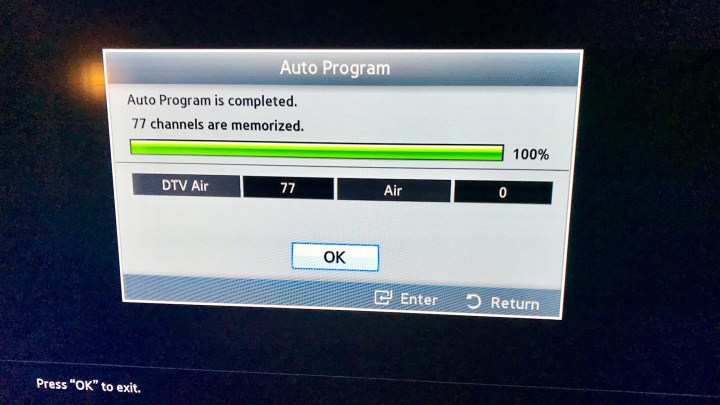
Broadcast TV: This is a no-brainer option for the RV-er. I recently upgraded my King Jack antenna to a newer model and noticed a significant improvement over the old digital antenna. My previous motorhome had the ancient ‘bat wing’ style antenna and I could not receive nearly as many stations. Broadcast TV undoubtedly has the best HD picture available. In the photo above I pointed my antenna to Phoenix (60 miles away) and scanned for channels. As you can see, I receive 77 channels in my current location (I also receive the Tucson channels off the backside of the antenna). That said, some channels are Spanish speaking, some are home shopping channels and some are religious programming (some are religious programming in Spanish). But I still get all of the major networks and a lot of usable, entertaining channels. What I don’t get are the Minnesota sports teams or local Minnesota news.
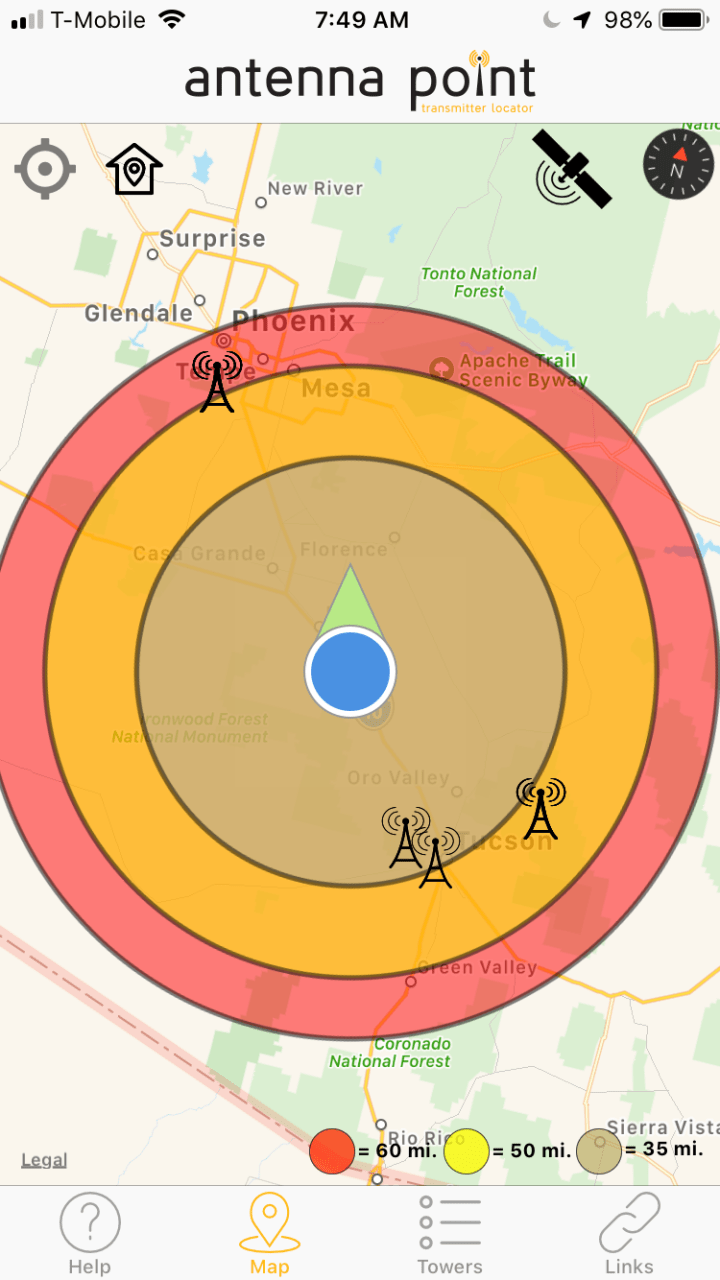
Antenna Point is a free cell phone app that uses GPS technology to help locate TV broadcast towers nearest to your location. This makes it easy to see what is available and where to point your antenna. If you’ve got an RV, upgrade your antenna and download the app.
Pros: Free over-the-air service, great picture quality.
Cons: Number of channels is dependent on location.
Slingbox: This is a box that sits in a home and rebroadcasts (streams) your cable or satellite TV to you, wherever you may be in the world, via the internet. I’ve been using this technology for over a year and for the most part, it’s adequate. When I was a homeowner, I had the Slingbox located in my home in Rochester. Today, I have it located at a friend’s home. Slingbox (not to be confused with Sling TV) uses apps for smart-phones, tablets and PCs to receive the signals via the internet. The signal can then be directed to your large screen TV in the RV via a cable connection to the HDMI port or by the use of casting technology (like Google’s Chromecast). The app features a virtual remote control that allows the viewer to send a signal via the internet back to the home box to change channels, pull up the channel guide and generally control the cable/satellite box from a remote location.
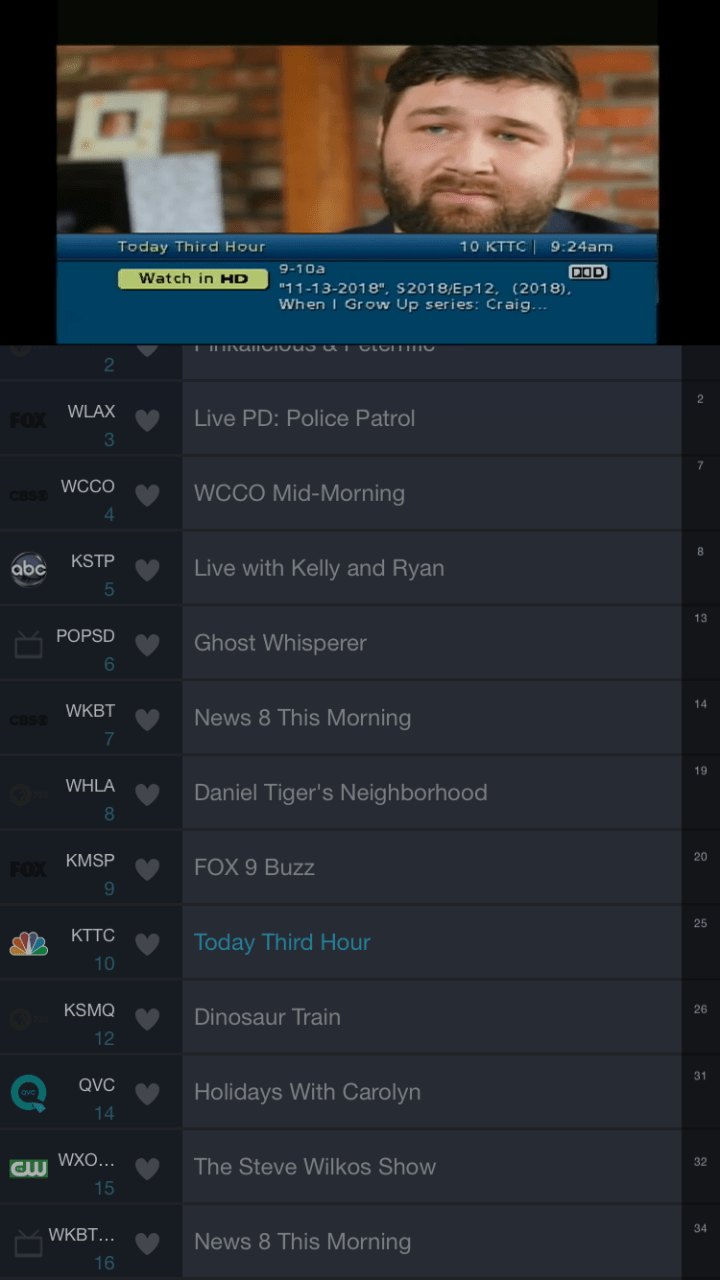 The screenshot above is from my iPhone and shows that I’m watching KTTC via the Slingbox while displaying the channel selection guide. This technology allows me to watch any SE Minnesota local programming, (including local news and Viking football) wherever I roam. The cost of this system is minimal. I paid $80 for a refurbished M2 Slingbox via Amazon and there is no monthly service fee. I’m covering the cost ($5/month) of an additional cable box at my friend’s home that’s dedicated for my use. The biggest downside to this technology is that it requires good internet connections at both ends. The friend who hosts the box for me has a great connection and the Slingbox is connected to his router via an Ethernet cable for the fastest speed. The problem for me occurs on the viewing end. When I have a slow connection, the streaming occasionally drops and I have to restart the app. The other downside is the quality of the picture. The app automatically adjusts the picture quality based on the speed of the internet service. Even under ideal internet conditions when I cast the picture from my cell phone to a larger screen TV, one can see that it’s a bit fuzzy. Slingbox is not going to please someone who demands a high quality picture. I’m on a great unlimited data plan from my cell provider T-Mobile that doesn’t slow the connection down after a data usage limit so it works fairly well with the Slingbox. Still, some areas have good cell signals with speedy LTE data available while others don’t.
Pros: Low cost, many channels, local programming from the Slingbox host site.
Cons: Picture quality dependent on internet speed, dropped connections.
Other Options: There are plenty of other internet-based subscription options (Sling TV, Roku, Fubu, etc.) for television viewing with some offering local programming options. Depending on your needs you can get one of these services in the $40-100/month range. Also, many broadcast stations and even some cable-only channels can be viewed for free via their websites. I’ve bookmarked some of these and occasionally use them as a last resort since the programming is fairly limited. As an Amazon Prime member not only do I get all of the 2-day free shipping on purchased items, I also receive their excellent video/television streaming service. Among other things, all of the Thursday Night Football games are live-streamed on Amazon at no additional cost and the quality of the picture is much better than I get from my Slingbox. As a T-Mobile customer, I get Netflix at no additional cost. I’ve been staying at state parks for most of my travels thus far, but many commercial RV parks have cable TV hook-ups at the camp sites that one can plug into.
My choice of broadcast TV and the use of a Slingbox allows me to get what I need at a minimal cost, at most locations on my travels. How important is television to you? If you watch more TV than I do perhaps a satellite system is a better choice for you. I’m sure that you noticed many of the options I discussed above for TV viewing are dependent on a good internet connection. In a future blog I’m going to talk about different internet connection options.
 Retirement & Life